
Preparing for 2026: The Future of DevOps Tools, Interview Trends, and Your Strategic Learning Map
The DevOps landscape is notoriously volatile. If you are preparing for interviews today, aiming for the standards of 2023 isn’t enough. To land top-tier roles in 2026, you need to anticipate where the industry is heading.
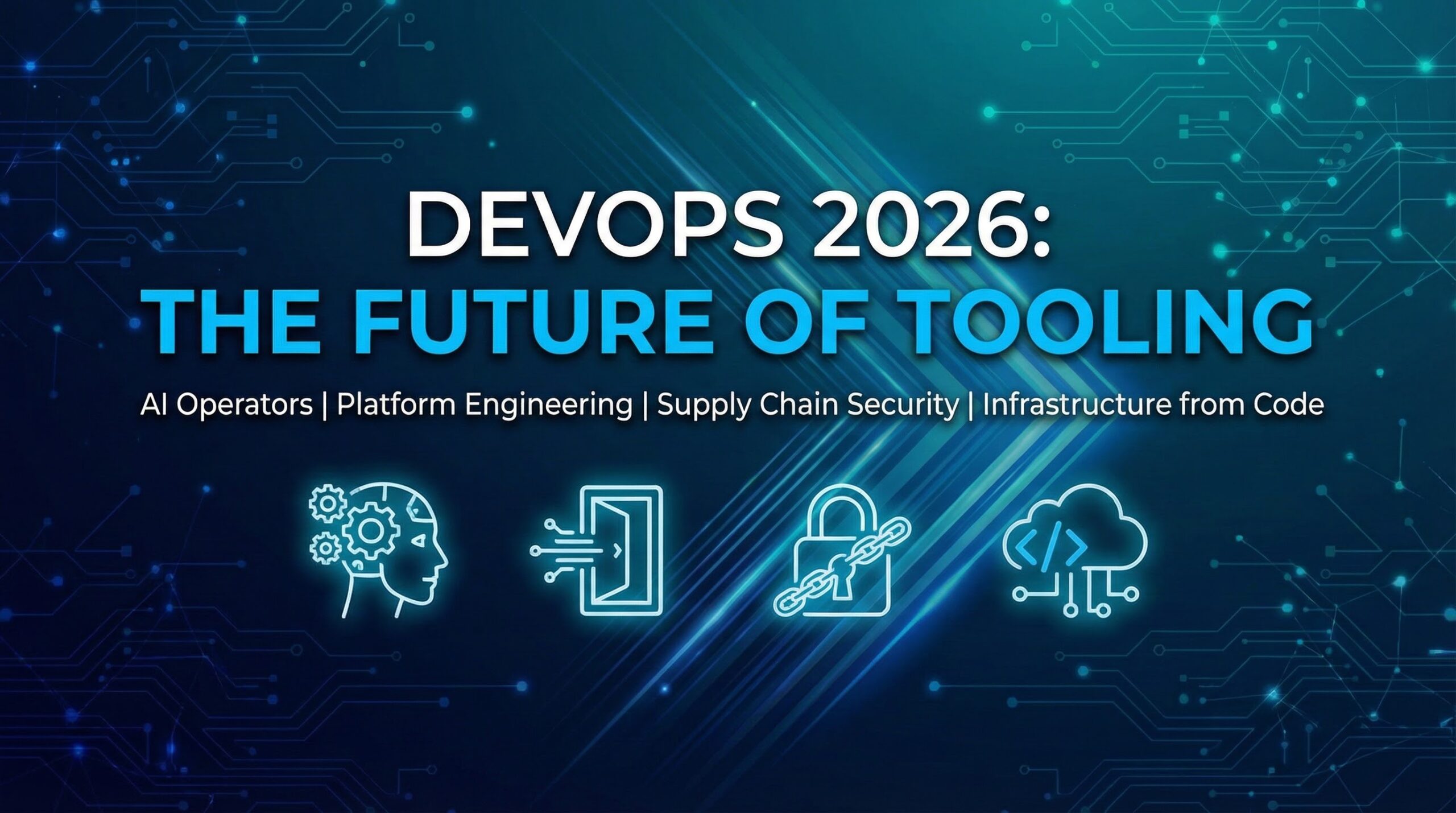
The era of the “DevOps Engineer” manually stitching together 50 disparate tools is ending. 2026 is the era of the Platform Engineer and the AI-Augmented Operator. The goal is no longer just pushing code; it’s providing self-service capabilities to developers while using AI to manage the increasing complexity of distributed systems.
Here is your guide to the tooling landscape of the near future, how to talk about it in interviews, and a map to learn it all.
The 4 Major Shifts Defining 2026 DevOps Tooling
We aren’t just seeing new tools; we are seeing new categories of tools mature.
Shift 1: From “Chatbots” to Autonomous AI Operators (AIOps 2.0)
In 2024/2025, we used GenAI to write scripts and summarize logs. By 2026, AI agents will be trusted to take autonomous actions within guardrails. We are moving from “human-in-the-loop” to “human-on-the-loop” for low-risk operational tasks.
The Tooling Trajectory: We are moving away from generic LLMs toward specialized, context-aware agents integrated directly into observability platforms.
- Tools paving the way: Kubiya.ai (delegating ops tasks via conversation), K8sGPT (scanning clusters and diagnosing issues with AI), and AI-native observability platforms that don’t just alert, but suggest remediation code.
The Interview Edge: Don’t just say “I use ChatGPT to write Python.”
- Say this instead: “I am interested in how we can implement autonomous AI agents to handle L1 incident remediation, like disk space clearing or pod restarts. The key challenge isn’t the AI action, it’s designing the governance guardrails to ensure the AI doesn’t make a bad situation worse.”
Shift 2: The Maturity of Platform Engineering (IDPs)
Kubernetes won the container war, but it lost the developer experience war. It’s too complex for the average application developer. 2026 is the year Internal Developer Platforms (IDPs) become standard in mid-to-large enterprises. The goal is to hide Kubernetes, not expose it.
The Tooling Trajectory: Tools that act as a “single pane of glass” catalog for developers to self-serve infrastructure without opening a Jira ticket.
- The Heavyweight Champion: Backstage (by Spotify). It is complex to set up but is the standard for developer portals.
- The Rising Stars: Port (an easier SaaS alternative to Backstage), Mia-Platform, and Kratix (focused on building platforms specifically for Kubernetes).
The Interview Edge: Don’t just talk about managing clusters.
- Say this instead: “I believe DevOps should evolve into Platform Engineering. My goal is to build an IDP using tools like Backstage or Port to reduce developer cognitive load. Developers should be able to spin up a compliant environment in five clicks without knowing what an Ingress Controller is.”
Shift 3: Software Supply Chain Security as Code (SSCS)
DevSecOps is evolving. It’s no longer enough to scan a container for vulnerabilities at the end of a pipeline. By 2026, regulatory pressure will demand that every artifact is cryptographically signed and has a verifiable Software Bill of Materials (SBOM) detailing its entire lineage from the first commit to deployment.
The Tooling Trajectory: Tools that focus on provenance (where did this code come from?) and signing.
- Tools paving the way: Sigstore (the standard for signing software), Chainguard (providing secure, minimal base images), Syft and Grype (for generating and scanning SBOMs).
The Interview Edge: Move beyond basic vulnerability scanning.
- Say this instead: “Security needs to shift way left. In 2026, we must implement a full chain of custody. I focus on implementing SBOM generation using Syft in the CI pipeline and using Sigstore Cosign to cryptographically verify images before the admission controller allows them into the production cluster.”
Shift 4: Infrastructure from Code (IfC) replacing IaC
Terraform and OpenTofu are excellent, but they create a disconnect between the application code and the infrastructure it needs. “Infrastructure from Code” is an emerging trend where the infrastructure needs are inferred directly from the application logic itself.
The Tooling Trajectory: While Terraform/OpenTofu will remain dominant for core networking layers, application infrastructure will move toward higher abstractions.
- Tools paving the way: Winglang (a cloud-oriented programming language), Nitric, Pulumi (using standard languages instead of HCL).
The Interview Edge: Show you understand the limitations of current IaC.
- Say this instead: “While I am proficient in Terraform for foundational infrastructure, I see a bottleneck in maintaining massive HCL codebases for application resources. I’m exploring approaches like Winglang or advanced CDK patterns to allow application code to define its own infrastructure requirements, speeding up development cycles.”
The 2026 DevOps Learning Map
You cannot jump straight to the 2026 tools without a solid foundation. This map is cumulative.
Phase 1: The Non-Negotiable Foundation (3-6 Months)
If you fail here, the advanced tools won’t make sense.
- Linux Mastery: File systems, permissions, bash scripting, networking basics (DNS, TCP/IP).
- Git Flow: Merge conflicts, branching strategies, pull requests.
- Container Fundamentals: Dockerfiles, multi-stage builds, understanding image layers.
- The Cloud Provider (AWS/Azure/GCP): IAM, basic networking (VPC), VMs (EC2), and object storage (S3).
Phase 2: The “Standard” DevOps Practitioner (3-6 Months)
This gets you hired in 2024/2025.
- Kubernetes Administration: Deployments, Services, Ingress, ConfigMaps, Secrets. (Learn to do it the hard way before using managed services like EKS/AKS).
- Infrastructure as Code (IaC): Terraform or OpenTofu. State management, modules.
- CI/CD Pipelines: GitHub Actions or GitLab CI. End-to-end automation with testing integration.
- Observability 1.0: Prometheus (metrics) and Grafana (visualization). Basic logging (ELK stack or Loki).
Phase 3: The 2026 Future-Ready Engineer (Ongoing)
This is where you differentiate yourself for top-tier roles.
- Platform Engineering: Build a basic developer portal using Backstage or Port. Create “golden path” templates for developers.
- Advanced Security (SSCS): Implement SBOM generation in your pipeline. Set up image signing with Sigstore. Use Policy-as-Code (Open Policy Agent – OPA or Kyverno) in Kubernetes.
- AI Integration: Learn how to use the OpenAI API or local LLMs to build a simple RAG (Retrieval-Augmented Generation) system for searching your own documentation or logs.
- FinOps: Learn cloud cost management tools (Kubecost) and how to architect for cost-efficiency.
Summary for Interviews
When interviewing for roles looking toward 2026, remember this mantra: Don’t just talk about the tools; talk about the problems the tools solve.
Employers in 2026 won’t just want someone who knows Kubernetes. They will want someone who knows how to tame Kubernetes so the rest of the company doesn’t have to think about it. Focus on developer experience, automated governance, and intelligent operations.

aslam
August 19, 2020Lorem ipsum dolor sit amet, consectetur adipiscing elit.
aslam
August 19, 2020Sed tincidunt, erat in malesuada aliquam, est erat faucibus purus, eget viverra nulla sem vitae neque.